
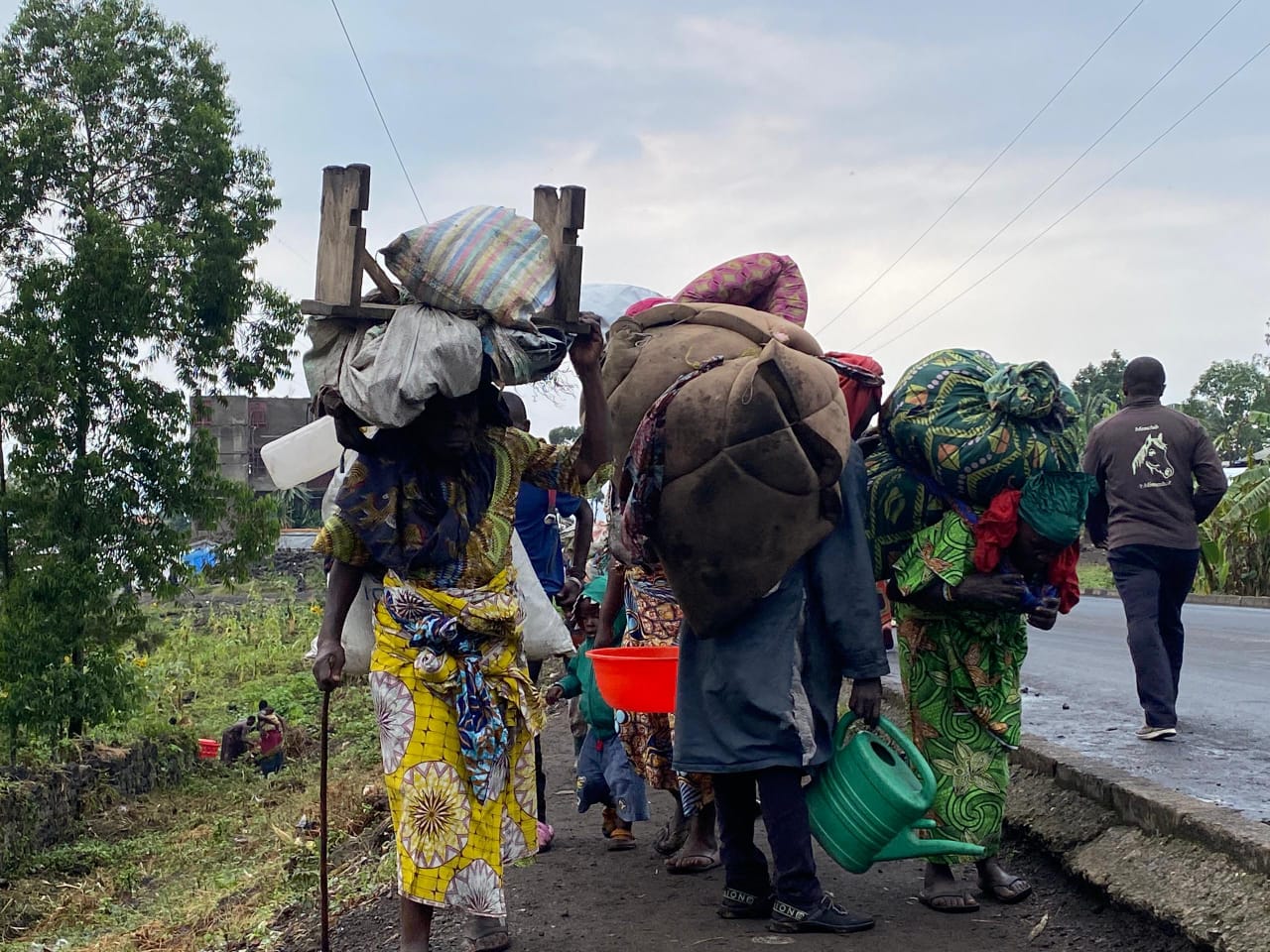
L’est de la République démocratique du Congo (RDC) continue de faire face à une grave crise humanitaire marquée par des déplacements massifs de population. Selon une série des rapports du Bureau de la coordination des affaires humanitaires des Nations unies (OCHA), publié entre le 6 et le 8 avril 2026, 3 756 300 personnes sont déplacées internes dans les provinces du Nord-Kivu, du Sud-Kivu et de l’Ituri.
Sud-Kivu : une situation aggravée dans les Hauts Plateaux
La province du Sud-Kivu enregistre environ 1 560 000 déplacés internes, selon OCHA. L’intensification des affrontements dans les Hauts Plateaux, notamment autour de Minembwe et dans le territoire de Fizi, a fortement détérioré la situation humanitaire.
Dans plusieurs zones enclavées, les restrictions de mouvement et la dégradation des infrastructures routières limitent l’accès humanitaire. Plus de 58 400 personnes déplacées depuis janvier 2026 restent difficiles à assister, avec des besoins urgents en sécurité alimentaire, santé et protection.
Dans le territoire de Kalehe, les combats dans les zones de Ziralo, Mubuku, Buzi et Mbinga ont également provoqué de nouveaux déplacements. Entre le 23 et le 24 mars, des attaques dans les villages de Bibatama et Chumuyaga ont fait six morts civils et déplacé plus de 3 500 personnes. Plusieurs cas de violences sexuelles et de vols de bétail ont également été signalés.
Nord-Kivu : insécurité persistante et déplacements continus
Au Nord-Kivu, la situation sécuritaire reste instable, avec 1 270 000 personnes déplacées internes.
OCHA signale notamment plus de 21 800 nouveaux déplacés dans le territoire de Lubero à la suite de nouveaux affrontements armés. Dans le territoire de Rutshuru, particulièrement dans la chefferie de Bwito, les combats ont provoqué des déplacements massifs sur plusieurs axes stratégiques.
Début mars, plus de 21 755 personnes ont fui les villages de Mirangi et Kyere vers d’autres localités de la zone de santé de Kibirizi. Par ailleurs, certains retours progressifs sont observés dans la zone de Bambo, où plus de 37 200 personnes ont regagné leurs localités d’origine depuis mai 2025, malgré des besoins humanitaires importants.
Ituri : violences meurtrières et déplacements massifs
Dans la province de l’Ituri, environ 926 300 personnes sont déplacées, principalement dans le territoire de Mambasa.
En mars 2026, une série d’attaques armées dans les zones de santé de NiaNia et Lolwa a fait au moins 87 morts et provoqué l’enlèvement de plus de 390 personnes, selon les autorités locales et les acteurs humanitaires.
Ces violences ont entraîné le déplacement de plus de 60 000 personnes, certaines fuyant vers d’autres localités de l’Ituri, d’autres vers la province voisine de la Tshopo.
Une crise humanitaire persistante
Selon OCHA, cette situation illustre la persistance d’une crise humanitaire majeure dans l’est de la RDC. Les déplacements massifs fragilisent les communautés locales et aggravent les besoins en abris, alimentation, soins de santé et protection.
Les femmes et les enfants restent particulièrement exposés aux violences, notamment aux violences sexuelles, dans un contexte sécuritaire toujours instable dans les provinces du Nord-Kivu, du Sud-Kivu et de l’Ituri.
LUKEKA MBILIZI NATHANAËL

Click Here For The Best Real Money Payid Casino
We will promptly notify you of any such action to pause
or cancel your PayTo Payment Agreement via Online Banking, Mobile Banking, or email.
Where we are unable to process your request (e.g. to cancel, amend or pause your PayTo Payment Agreement), we
will notify you this in Online Mobile Banking, and you may need
to contact your merchant or Payment Initiator to action your request.
We will respond to all claims within 5 business days, and
if the claim is founded, we will refund your Account.
If the merchant or Payment Initiator cancels a PayTo Payment Agreement to which you are
a party, we will promptly notify you of that cancellation via
Online Banking, Mobile Banking, or email. The Mandate Management Service will notify the merchant’s or Payment Initiator’s financial institution or payment
processor of the cancellation. If the merchant or Payment
Initiator pauses a PayTo Payment Agreement to which you are a party, we will promptly notify you of that,
and of any subsequent resumption, via Online Banking,
Mobile Banking, or email. The Mandate Management Service will
notify the merchant’s or Payment Initiator’s
financial institution or payment processor of the pause or resumption.
10.4 You should check your payment records and receipts carefully and promptly report any error to us by calling our contact centre.
« Mobile Device Passcode » means anything required to unlock a mobile device including a password, passcode,
pattern or biometric identifier (where applicable). Business payment debits rely on processing
by other financial institutions and we cannot advise when these payments will be processed to
your customers account. Online Banking means the online banking service registered in the name of an individual to manage
their banking online, and in the case of an organisation, refers
to Online Banking for business, unless the context specifies otherwise.
Mobile device means a mobile phone that is able to access
Westpac Mobile Banking, a tablet device that is able to access Westpac Tablet Banking, or another
type of personal electronic device as described in the Help
centre that is able to access specific Online Banking services.
The Transaction will not be successfully
processed until it has been authorised by two signatories.
If a transfer cannot be processed by the receiving financial institution, the funds
will be returned to your Account. All details of Online Telegraphic Transfers must be checked before submitting.
You must check the details of each Pay Someone Transfer,
Online Telegraphic Transfer and each Transaction in a
business payment and ensure that the accounts, B.S.B., PayID Bank Codes and
amounts are correct. For details about Confirmation of Payee
refer to the Terms and Conditions for Suncorp Bank Accounts
and for Continuing Credit Accounts.
We may choose not to provide you with notice if we determine
it is reasonably necessary. It’s your responsibility to check your email regularly for these notifications and to
access the documents promptly following our email.
You can withdraw your consent to receiving documents electronically
at any time and revert to paper documents by changing your
preferences by account type in Online Banking. It’s your
responsibility to check your email regularly for these
notifications and to access your statement promptly following our email.
If you are eligible to receive paper statements on your
nominated Account(s) and you stop receiving paper statements, you can revert to paper
statements at any time by changing your preferences in Online
Banking or contacting us. These transaction records will
usually be available the following Business Day.
Ways to achieve this include choosing a Password that nobody could guess, not using one that includes your name,
date of birth (or part thereof) or a combination of these, and not using the same password
that is used for other services such as your email service.
If this occurs, please call our contact centre to reactivate
your Online Banking access. While we do our best to categorise transactions by matching the transaction description to the pre-defined sub-categories, at times the applied sub-category may not reflect your preference.
(c) any subsequent request made on the online consent dashboard in Online Banking
to enable data sharing on the joint account will need to be approved by all joint account holders within a
specified period of time. When a joint account is enabled, any Open Banking
data sharing authorisations created by one account holder are taken to have been pre-approved
by all account holders. 15.3 Where the virtual assistant or our staff (if
you have been connected to a human) is not able to assist with your query over
the chat service, we may refer you to our Telephone Banking team or a
Westpac branch. 14.4 You may terminate your use of Online Banking at any time by giving us written notice, making
a request in the Mobile Banking App, or calling our contact centre.
6.7 Where the sending institution is not satisfied that a payment
is a Mistaken Internet Payment, it is not required to take any further action,
however it may choose to contact the unintended recipient and explain that
a person has claimed that a transaction was mistaken. 6.3 We will acknowledge receipt
of your report of a mistaken internet payment, conduct an investigation into that mistaken internet payment, and inform
you in writing of the outcome of our investigation within 30 business days of the day on which you made the report.
This limit on liability does not apply to customers of Online Banking for business please refer to below section « Online Banking for business » 5.8 You’ll
also be liable for actual losses resulting from unauthorised transactions made using Online Banking caused by the User unreasonably delaying notifying us of the misuse,
loss or theft of a Mobile phone, Security device, or of their Access code(s) becoming known to someone else.
5.2 For the purposes of this clause 5, a reference to you or your means the Account holder of the Account from which
an unauthorised transaction has occurred. 4.5 If
you’re using Mobile Banking, you must also not write your
Customer number, Password or Mobile passcode on your Mobile device or keep a record of any of them near the Mobile device.
4.3 If you make a record of your Access code you must keep that record separate and well away from any electronic equipment (such as a computer or Mobile phone) or
any other Access code or Security device you use to access Online Banking unless the Access
code is reasonably disguised.
If this is the case, you may need to demonstrate that an error has
occurred, based on your own records, or liaise directly with the
Biller to correct the error. For example, we or your Biller may
not have sufficient records or information available to us
to investigate the error. 4.5 We will attempt to make sure that your payments, including payments which are the subject of Batch Payer Directions, are processed promptly by the participants in BPAY Payments, including those
Billers to whom your Payments are to be made.
For details refer to the terms and conditions for the Account from which you have
selected as the source of the payment. For details refer to the terms and conditions for the Account from which you’re making a payment.
3.6 If you are registered for a Security device and
are making a payment to a new BPAY biller and customer reference number
combination you’ve not paid before, you’ll
be required to enter an Access code to confirm your payment.
BPAY View is a service that allows you to receive or access bills or statements electronically from participating Billers nominated
by you and which enables you to choose to pay the Biller electronically using a payment method
accepted by the Biller.
The Australian Financial Complaints Authority (AFCA) provides a free and independent service to resolve complaints by consumers
and small businesses about financial firms (e.g.
banks), where that complaint falls within AFCA’s terms of reference.
Should we be unable to resolve your concern at your
first point of contact, we will then refer the compliant to our dedicated Customer
Managers in our Customer Solutions team. Our aim is to resolve your complaint within 5 business days,
and where possible we will resolve your complaint on the spot.
References:
payidpokies1.com